




Request download
...

.png) Reading list
Reading list


This topic explores what culturally informed or culturally appropriate approaches to monitoring and evaluation (M&E) might look like. It provides many examples from First Nations groups in Australia and internationally. The topic highlights the importance of cultural principles, values and storytelling in M&E practices. It also explores community-led and participatory approaches to monitoring and evaluation.
While reading this topic, think about the following questions and how they relate to your organisation, community or nation:
What makes monitoring and evaluation culturally informed and relevant? According to the Queensland Aboriginal and Torres Strait Islander Child Protection Peak Limited (QATSICPP), culturally grounded evaluations are:
Building on this, culturally informed approaches to monitoring and evaluation place Indigenous cultures, traditions, relationships and lived experiences at the centre. These approaches recognise that meaningful evaluation must reflect the values and ways of knowing of the people it relates to.
Culturally informed monitoring and evaluation can take many forms across different contexts.
Common features often include:
Culturally informed monitoring and evaluation can be applied in practice in many ways. Below, we look at how culturally informed monitoring can be operationalised across some key areas:
Governance and decision making
An example of culturally informed monitoring and evaluation is the Stronger Communities for Children (SCfC) program, where local community boards play a central role in setting priorities, guiding implementation and assessing outcomes.5Australian Institute of Family Studies, “Stronger Communities for Children: Community involvement in Indigenous program evaluation,” 2017, [link].
The program is supported by Ninti One, a not-for-profit organisation working alongside service providers and communities to design evaluation approaches that balance local priorities with funder requirements.6Stewart Muir and Adam Dean, Evaluating the outcomes of programs for Indigenous families and communities, CFCA Practice Resource, (Melbourne: Australian Institute of Family Studies, 2017), 4, [link]; Ninti One, “Stronger Communities for Children,” accessed March 2023, [link].
Community governance is central to this approach. Local advisory groups (SCfC Boards) work with their communities to identify needs, set priorities and guide program design and delivery. These groups are supported by Ninti One through training and capacity-building to use data and evaluation findings in decision-making.7Stewart Muir and Adam Dean, Evaluating the outcomes of programs for Indigenous families and communities, CFCA Practice Resource, (Melbourne: Australian Institute of Family Studies, 2017), 4, [link]; Ninti One, “Stronger Communities for Children,” accessed March 2023, [link].
In one example, a local board developed a community plan outlining its goals and priorities, and used this to design an impact assessment framework covering short, medium and long-term outcomes. The board identified locally relevant indicators of change and were taught how to use a mix of methods, including surveys, interviews, community observations and existing data, to assess progress. This enabled the community to determine whether programs were achieving intended outcomes and to inform future improvements.8Stewart Muir and Adam Dean, Evaluating the outcomes of programs for Indigenous families and communities, CFCA Practice Resource, (Melbourne: Australian Institute of Family Studies, 2017), 4, [link]; Ninti One, “Stronger Communities for Children,” accessed March 2023, [link].
Evaluation design and methods
Ethical practice
Participation and inclusion
Child Family Community Australia highlights that community consultation and participation are critical across all stages of evaluation. This engagement should be from the outset of the evaluation. Community members and local researchers, like program staff, participants and other stakeholders, bring important contextual knowledge and are well placed to identify factors that may support or hinder the evaluation. Their involvement helps ensure that evaluation approaches are relevant and culturally appropriate.2Stewart Muir and Adam Dean, Evaluating the outcomes of programs for Indigenous families and communities, CFCA Practice Resource, (Melbourne: Australian Institute of Family Studies, 2017), 4, [link].
QATSICPP’s Evaluation Framework recognises that the voices of Aboriginal and Torres Strait Islander children and young people are central to evaluation design in this sector. One of their key standards states: “We hear and respond to the voices of Aboriginal and Torres Strait Islander Children and Young People”.3Queensland Aboriginal and Torres Strait Islander Child Protection Peak Limited (QATSICPP), Evaluation Framework, 2024, 13, [link].
This standard is operationalised in several ways:
Indigenous Data Governance and Sovereignty
Indigenous peoples retain ownership, control and authority over their data. They determine:
Strengths-based approach
Adopt a strengths-based lens and move beyond deficit-focused narratives by:
Wiyi Yani U Thangani’s Change Agenda sets out a framework for understanding and measuring change grounded in the voices and experiences of Aboriginal and Torres Strait Islander women and girls.3 Wiyi Yani U Thangani, Change Agenda for First Nations Gender Justice (Australian Human Rights Commission, 2024) [link]. In regard to data, their Change Agenda notes that:
Use of findings and accountability
Ensure findings are:
Link evaluation to action and accountability, including:
Many Indigenous M&E approaches include a set of principles that help guide what is measured, and how data is collected, analysed and shared. The principles that guide Indigenous M&E are linked to the cultural beliefs and values important to the group. As with other aspects of Indigenous monitoring and evaluation, these principles will vary depending on the group and the sector they operate in.
The examples below illustrate how different groups have defined and applied their own evaluative principles.
The QATSICPP Evaluation Framework includes a set of principles and evaluation standards that are tailored to their work with children and young people.3Queensland Aboriginal and Torres Strait Islander Child Protection Peak Limited (QATSICPP), Evaluation Framework, 2024, [link]. The key evaluation principles that underpin their framework are:
These principles are supported by a set of evaluation standards that translate them into practice. For more detail on this, see their full framework.
A large-scale approach to Indigenous monitoring and evaluation is the Indigenous Evaluation Strategy developed by the Productivity Commission. The Strategy was commissioned by the Australian Government to improve how policies and programs affecting Aboriginal and Torres Strait Islander people are evaluated, recognising that stronger evaluation practices can lead to better outcomes.5Productivity Commission, Indigenous Evaluation Strategy, 2020, 2, [link]. It is intended for use across all government agencies and applies to both Indigenous-specific and mainstream programs. The Strategy sets out a whole-of-government framework that places Aboriginal and Torres Strait Islander people at the centre of evaluation.6Productivity Commission, Indigenous Evaluation Strategy, 2020, 2, [link].
A set of guiding principles underpins the Strategy, outlining what good practice looks like for government agencies. These principles are designed to be flexible and allow agencies to adapt their evaluation approaches to suit different programs and community contexts.7Productivity Commission, Indigenous Evaluation Strategy, 2020, 8-9, [link]. The overarching principle is to centre Aboriginal and Torres Strait Islander people, perspectives, priorities and knowledges. This is supported by secondary principles that emphasise evaluations being credible, useful, ethical and transparent.8Productivity Commission, Indigenous Evaluation Strategy, 2020, 8-9, [link].
The Making Tracks Together: Monitoring and Evaluation Framework’s evaluative principles are grounded in the values, cultural authority and lived experiences of First Nations peoples identified through a co-design process. These principles underpin all aspects of the framework:
The evaluation questions laid out in the framework use these principles as guiding prompts to think more deeply about important issues such as:
The American Indian Higher Education Consortium’s Indigenous Evaluation Framework is guided by a set of principles, including drawing on Indigenous values and cultural expressions, being flexible to change depending on local contexts, taking ownership and ensuring evaluation respects and serves goals for self-determination and sovereignty.2 American Indian Higher Education Consortium, Joan LaFrance and Richard Nichols, Telling Our Story in Our Place and Time: Indigenous Evaluation Framework, Alexandria, VA, 2009, 4. The full outline of AIHEC’s principles is outlined in their Evaluation Framework.
A common feature across many Indigenous evaluation frameworks is that they are guided by values. Like principles, these values will differ from group to group. Some of the values that guide Indigenous evaluation approaches might be linked to the deep cultural features that many Indigenous groups share. It is likely they will be quite specific to your group and the people it serves.
In 2018, the Urban Indian Health Institute (UIHI) developed an Indigenous Evaluation Framework grounded in four key cultural values:
Building on these values, Indigenous practitioners working with survivors of violence emphasised that evaluation should contribute to restoring Indigenous systems of care and protection for women and girls. This led to the identification of three additional intentions to guide evaluation practices:
The AIHEC Indigenous Evaluation Framework places evaluation within Indigenous ways of knowing. AIHEC have identified four core values that shape how evaluation is approached in Indigenous communities.4American Indian Higher Education Consortium, Joan LaFrance and Richard Nichols, Telling Our Story in Our Place and Time: Indigenous Evaluation Framework, Alexandria, VA, 2009, 7. By centring these values and ways of knowing, the framework enables the adaptation and use of non-Indigenous evaluation methods in ways that are culturally appropriate and relevant. Focus groups conducted as part of the Indigenous Evaluation Framework identified several core values that are widely shared across many tribal cultures. These were:
AIHEC ask the important question: “Is there a set of core beliefs or common values that can serve as a foundation for framing a tribal approach to evaluation?”6American Indian Higher Education Consortium, Joan LaFrance and Richard Nichols, Telling Our Story in Our Place and Time: Indigenous Evaluation Framework, Alexandria, VA, 2009, 31.
Evaluation is not just a technical exercise carried out by groups. It needs to be informed by the things that matter to communities. By explicitly identifying these values, evaluators and communities can design approaches that are culturally relevant. The AIHEC table, shown below, is a clear example of how beliefs about knowledge and cultural values can shape evaluation practice in communities:3American Indian Higher Education Consortium, Joan LaFrance and Richard Nichols, Telling Our Story in Our Place and Time: Indigenous Evaluation Framework, Alexandria, VA, 2009, 39.
The table below adapts the AIHEC framework to better reflect values commonly used in the Australian context.4American Indian Higher Education Consortium, Joan LaFrance and Richard Nichols, Telling Our Story in Our Place and Time: Indigenous Evaluation Framework, Alexandria, VA, 2009, 39. It is an example only, as values will differ across communities, organisations and sectors.
| Value | How is this reflected in evaluation? |
|---|---|
| Connection to Country |
|
| Indigenous Data Sovereignty |
|
| Youth voice |
|
| Traditional ways of knowing |
|
| Community and relationships |
|
| Strengths-based |
|
| Self-determination |
|
| Capacity building |
|
Many Indigenous monitoring and evaluation approaches see storytelling as a key part of M&E work. These approaches highlight the importance of capturing and sharing stories as a way of understanding change. This reflects a broader shift towards recognising lived experiences as forms of evidence. In NSW, for instance, consultation for a First Nations evaluation framework identified a need for evaluation practice to better incorporate qualitative feedback, including the stories and experiences of First Nations peoples, and to place greater emphasis on community data and storytelling in building the evidence base.5NSW Treasury, Shaping evaluation of policies and programs impacting First Nations people – Consultation listening series (First Nations Economic Wellbeing Branch, 2022), 22-23.
For the U.S-based Urban Indian Health Institute (UIHI), sharing evaluation stories is a core element of their framework.3L. Polansky and A. Echo-Hawk, Building the Sacred: An Indigenous Evaluation Framework for Programs Serving Native Survivors of Violence (Seattle, WA: Urban Indian Health Institute, Seattle Indian Health Board, 2021), 10-18. In many evaluation approaches, a strong focus on outputs, such as the number of clients served or activities delivered, can mask the deeper stories behind the work. In Indigenous contexts, these stories are a critical part of understanding impact. There are four areas of their framework which help develop evaluation stories:
Planting and Nurturing Seeds of Strength
Healing—Extending Space for Grief and Healing
Adapting in Community
For each area, UIHI presents a set of question prompts to help document the stories.4L. Polansky and A. Echo-Hawk, Building the Sacred: An Indigenous Evaluation Framework for Programs Serving Native Survivors of Violence (Seattle, WA: Urban Indian Health Institute, Seattle Indian Health Board, 2021), 10-18.
In their Building the Sacred framework, the Urban Indian Health Institute (UIHI) notes how in many non-Indigenous evaluation contexts, measures and indicators are often framed using deficit-based language that does not align with Indigenous worldviews.6L. Polansky and A. Echo-Hawk, Building the Sacred: An Indigenous Evaluation Framework for Programs Serving Native Survivors of Violence (Seattle, WA: Urban Indian Health Institute, Seattle Indian Health Board, 2021), 6. For example, terms such as ‘needs assessments’ tend to focus primarily on gaps or problems, without recognising the broader context of strengths, knowledge, relationships and cultural practices that shape wellbeing.7L. Polansky and A. Echo-Hawk, Building the Sacred: An Indigenous Evaluation Framework for Programs Serving Native Survivors of Violence (Seattle, WA: Urban Indian Health Institute, Seattle Indian Health Board, 2021), 6. This narrow framing can overlook the depth and complexity of Indigenous perspectives.
Culturally relevant measures and indicators, by contrast, are developed in partnership with communities and reflect locally defined ways of understanding success or change. They create space for Indigenous people to tell their own stories, using methods and forms of evidence that are meaningful to them. This may include qualitative approaches such as storytelling, observation and community-defined indicators of change, alongside quantitative data. Below, we share an example of how Indigenous-defined indicators can be incorporated into established evaluation systems:
The Australian Government uses the Monitoring, Evaluation, Reporting and Improvement (MERI) system as a framework for tracking and assessing natural resource management programs.5Australian Government, Department of Climate Change, Energy, the Environment and Water, “Monitoring, Evaluation, Reporting and Improvement (amber)”, updated October 2025, [link]. MERI provides a structured approach to understanding what is happening, what it means and how programs can be improved over time. It is also an important part of the management plans developed by Traditional Owners for Indigenous Protected Area (IPA) managers.6Australian Government, Department of Climate Change, Energy, the Environment and Water, “Monitoring, Evaluation, Reporting and Improvement (amber)”, updated October 2025, [link].
At its core, MERI involves four key components:
The MERI framework offers practical guidance for implementation. For example, in monitoring, it requires program managers to identify appropriate indicators, define how they will be measured and determine how results will be reported.7Australian Government, Department of Climate Change, Energy, the Environment and Water, “Monitoring, Evaluation, Reporting and Improvement (amber)”, updated October 2025, [link]. This provides a clear structure for planning and assessing progress. An example is below:8 Australian Government, Department of Climate Change, Energy, the Environment and Water, A guide to monitoring and evaluation for your Indigenous Protected Area (August 2025), 4, [link].
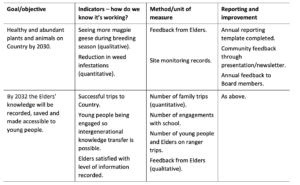
At the same time, the application of MERI in Indigenous contexts often involves adapting the framework to align with local cultural values and ways of working.
Effective evaluation in Indigenous contexts often requires an approach that combines conventional data collection with storytelling and creative methods. This ensures that evaluations capture both measurable outcomes and the narratives that define community experiences. The Urban Indian Health Institute (UIHI) uses a combination of gathering methods and storytelling methods (also known as “data collection” and “dissemination” methods) to gather their evaluation stories.8 L. Polansky and A. Echo-Hawk, Building the Sacred: An Indigenous Evaluation Framework for Programs Serving Native Survivors of Violence (Seattle, WA: Urban Indian Health Institute, Seattle Indian Health Board, 2021), 17-19. These include:
What is notable about the above points is that they combine qualitative and quantitative methods.
The following table provides a basic example of how to organise and track data across different domains (these might be strategic priorities or areas of focus identified by your group), combining qualitative and quantitative indicators. It can help evaluators and communities plan and document evaluation data.
Note: The example uses a fictional organisation supporting Indigenous women artists to illustrate how this approach can be applied in practice.
| Domain | Indicator | Type | Measurement methods | Data collector |
|---|---|---|---|---|
| Wellbeing | Reported sense of personal empowerment | Qualitative (narratives or testimonials) | Interviews/talking circles/artist statements | Community members or evaluators |
| Economic | Sales of artworks | Quantitative | Sales records | Program staff |
In the above example:
Domains are broad areas of focus, such as cultural connection, economic outcomes, health, etc.
Indicators are specific outcomes or measures that reflect success in each domain.
Data type records the type of data collected and, if relevant, its format.
Measurement methods note how each indicator will be measured (interviews, storytelling, surveys, program records, observation, art, etc.).
Data collectors are those who gather and record the data. This may include community members, program staff, or external evaluators.
An important part of any evaluation is deciding how findings and outcomes will be shared (disseminated) with the community and other stakeholders. Data dissemination should be culturally relevant and accessible. Some key considerations include:
Audience: Who needs to see the findings? This may include community members, Elders, program staff, funders or partner organisations.
Format: Use culturally appropriate formats such as storytelling, talking circles, visual maps, art, music, or written reports (depending on community preferences).
Language and accessibility: Present findings in the community’s language, if appropriate. Consider age, visual and other accessibility needs.
Participation: Where possible, involve the community in interpreting and sharing the findings to ensure they reflect local perspectives and values.
Ethical considerations: Ensure confidentiality, respect for sensitive knowledge and that culturally significant information is shared only with permission.
Follow-up: Use dissemination to support decision-making, inform program improvements and reinforce community ownership of the evaluation process.
The Guidebook for Participatory Monitoring & Evaluation of Jointly Managed Parks in the NT (the Guidebook) define participatory monitoring and evaluation (PME) as “an inclusive and collaborative monitoring (checking) and evaluation (learning to improve) process where all key stakeholders are actively engaged in all phases of the assessment from development of a monitoring and evaluation framework through to all phases of its implementation”.10A. Izurieta, N. Stacey, and J. Karam, with contributions by M. Moyses et al., Guidebook for Supporting Participatory Monitoring and Evaluation of Jointly Managed Parks in the Northern Territory (Darwin: Research Institute for the Environment and Livelihoods, Charles Darwin University, 2011), [link], 4. The Guidebook outlines four phases to PME:
Phase 1 is when the partners agree on processes, agree on the indicators and prepare to carry out the assessment.
Phase 2 involves collection of data (interviews and documents).
Phase 3 is when all information and data are jointly analysed, indicators are given values, and the first draft evaluation report is produced.
Phase 4 is when results of the assessment are shared with all partners and other stakeholders, allowing them to provide feedback and recommendations. It is also when results are validated.11A. Izurieta, N. Stacey, and J. Karam, with contributions by M. Moyses et al., Guidebook for Supporting Participatory Monitoring and Evaluation of Jointly Managed Parks in the Northern Territory (Darwin: Research Institute for the Environment and Livelihoods, Charles Darwin University, 2011), [link], 7.
Each phase has its own set of steps that can be followed through. View the Guidebook for more information on how to approach PME.
In 2024, an evaluation project explored the impacts of Mongolia’s land conservation policies on the traditions and daily lives of the Tsaatan Indigenous community in Mongolia.5 Oyuntulkhuur Jukov, Gereltsetseg Adiya, Itgemjit Gankhuyag and Azjargal Amarsanaa, Elevating Tsaatan Voices: Sowing the Seeds of Evaluation in Mongolia: Evaluation Report (APEA, EvalIndigenous, MEA and EvalPartners: 2025). The research applied a participatory and culturally responsive evaluation framework by the Toolkit on Indigenous Evaluations for the Asia-Pacific Region.
The participatory evaluation approach was foundational to the project. A capacity-building workshop was conducted with sixteen Tsaatan representatives from the East and West Taiga tribes 6 Oyuntulkhuur Jukov, Gereltsetseg Adiya, Itgemjit Gankhuyag and Azjargal Amarsanaa, Elevating Tsaatan Voices: Sowing the Seeds of Evaluation in Mongolia: Evaluation Report (APEA, EvalIndigenous, MEA and EvalPartners: 2025), 7. The workshop introduced participatory evaluation methods and strengthened participants’ skills to engage in policy discussions effectively. Data collection was also collaborative. Focus group discussions, key informant interviews and individual interviews were conducted with guidance and input from community representatives.7 Oyuntulkhuur Jukov, Gereltsetseg Adiya, Itgemjit Gankhuyag and Azjargal Amarsanaa, Elevating Tsaatan Voices: Sowing the Seeds of Evaluation in Mongolia: Evaluation Report (APEA, EvalIndigenous, MEA and EvalPartners: 2025), 7. This ensured that questions, methods, and interpretations reflected Tsaatan priorities and cultural knowledge. Findings were also discussed and validated with participants, so the Tsaatan could contribute directly to interpretation and policy recommendations.8 Oyuntulkhuur Jukov, Gereltsetseg Adiya, Itgemjit Gankhuyag and Azjargal Amarsanaa, Elevating Tsaatan Voices: Sowing the Seeds of Evaluation in Mongolia: Evaluation Report (APEA, EvalIndigenous, MEA and EvalPartners: 2025), 7.
QATSICPP take a practical, relationship-based approach to evaluation.3 Queensland Aboriginal and Torres Strait Islander Child Protection Peak Limited (QATSICPP), Evaluation Framework, 2024, 17, [link]. Some of their key considerations that may be useful for Toolkit users include:
The Making Tracks Together: Queensland’s Statewide First Nations Health Equity Strategies Monitoring and Evaluation Framework is a strong example that brings together many of the above considerations, including participatory approaches and diverse “ways of knowing” for assessing impact.6Making Tracks Together: Monitoring and Evaluation Framework (Brisbane: State of Queensland, Queensland Health, and Queensland Aboriginal and Islander Health Council [QAIHC], 2024), 23. It combines four complementary evaluation approaches.7Making Tracks Together: Monitoring and Evaluation Framework (Brisbane: State of Queensland, Queensland Health, and Queensland Aboriginal and Islander Health Council [QAIHC], 2024), 22. While the framework is detailed, a summary of the four approaches is provided below:
Evaluative principles
A set of principles that reflect the values, cultural authority and experiences of Indigenous peoples consulted throughout the co-design phase. These principles have been explored in more detail in the resource: Making Tracks Together: Monitoring and Evaluation Framework’s evaluative principles.8Making Tracks Together: Monitoring and Evaluation Framework (Brisbane: State of Queensland, Queensland Health, and Queensland Aboriginal and Islander Health Council [QAIHC], 2024), 22.
Empowerment evaluation
Focuses on building community capacity and shared ownership of evaluation.9Making Tracks Together: Monitoring and Evaluation Framework (Brisbane: State of Queensland, Queensland Health, and Queensland Aboriginal and Islander Health Council [QAIHC], 2024), 23. There are
two streams:
Practical stream
Transformative stream
Three ways of knowing
The evaluation integrates three evidence sources:
1. Quantitative and system data. Measures:
2. Narrative evidence. Often collected using yarning and participatory methods. Stories and qualitative insights from:
3. Economic assessment. Assesses:
Participatory Action Research (PAR)
PAR is a community-driven, empowerment-focused approach.10Making Tracks Together: Monitoring and Evaluation Framework (Brisbane: State of Queensland, Queensland Health, and Queensland Aboriginal and Islander Health Council [QAIHC], 2024), 24.
It engages multiple perspectives:
Benefits:
