


...


.png)

Circular Head Aboriginal Corporation (CHAC)
Website:
https://www.chac.com.au/
About:
CHAC is an Aboriginal-led organisation grounded in culture, community and self-determination, offering wrap-around holistic services to individuals, families and broader communities from the North West of Tasmania.
Purpose:
CHAC represents Aboriginal people in Circular Head, delivering holistic services that support individuals, families, and the wider Aboriginal community across North West Tasmania.
Based in:
Smithon, Tasmania, Peerapper Country
Service area:
Circular Head, North West Tasmania
Sector:
Community, health, family services.
Incorporated?:
Incorporated under the CATSI Act
Governance structures:
- Corporation
- Community controlled
This profile last updated:
Most recent update – April 2026.
SHARE

Download


About
Circular Head Aboriginal Corporation (CHAC) is an incorporated organisation delivering a broad range of services that support individuals, families, and the wider Circular Head community. CHAC represents the twelve tribes of Tasmania’s North West Region, whose cultures, languages, and histories inform and guide everyday practice across the organisation and community.
Established in 1994, CHAC began as a small, community-driven group focused on supporting young children through education and mentoring. It has since grown into a key support and advocacy organisation for Aboriginal people in Circular Head. As of 2025, CHAC delivers 18 programs and services, supported by 58 staff and a strong volunteer network, operating across five sites in Smithton and the surrounding region, including offices, health and cultural facilities, and on-Country grounds at Trawmanna.
CHAC’s mission is to embrace culture as a source of inspiration and empowerment for Aboriginal people. Guided by the knowledge and wisdom passed down through generations, CHAC supports individuals and families to live with pride in their identity and culture, delivering culturally responsive services that strengthen self-determination, confidence, and wellbeing.1 Circular Head Aboriginal Corporation, Circular Head Aboriginal Corporation & tarkiner Annual Report 2024-25, [link] As of 2025, more than 540 members make up the CHAC community — each contributing to a shared story, strength, and future.
Current community-based services offered by CHAC include:
- Maternal and early childhood health
- Aged Care and Disability services
- Justice support
- Mental health services
- Culture and language programs.
CHAC also acts as a voice and advocate for Aboriginal and Torres Strait Islander communities across Tasmania, particularly in the North West. Through a dedicated advocacy team, the organisation actively engages in formal consultations, correspondence, meetings, forums, and media opportunities across government, the private sector, and community initiatives—ensuring Aboriginal and Torres Strait Islander voices are consistently represented and heard in decision-making spaces.
CHAC’s governance structure
CHAC’s governance is grounded in cultural lore and practices, with community voices at the centre of decision-making. Members nominate and elect the board of directors, ensuring an Aboriginal majority in board and leadership roles. These structures honour self-determination and cultural authority beyond compliance.2 Rochelle Godwin, Communications & Engagement Manager, e-mail to Australian Indigenous Governance Institute, 6 November 2025.
Elders and community at the centre of CHAC’s organisational structure
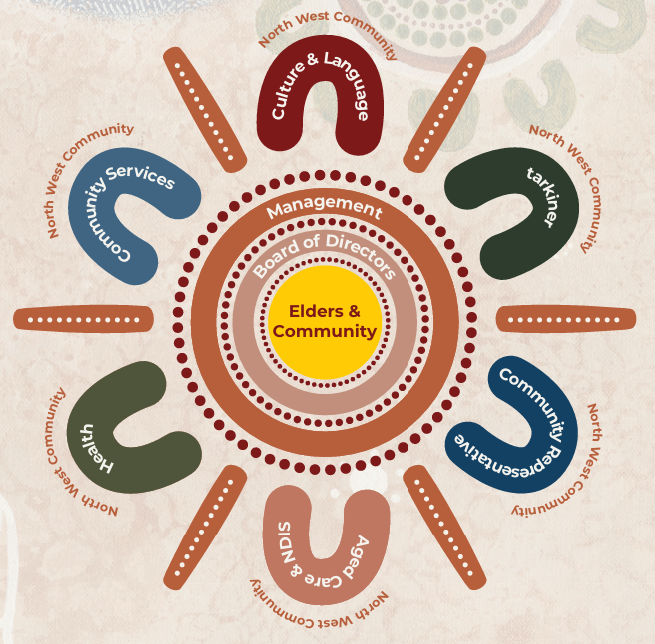
CHAC is governed by a board of ten Directors and Executive Officers elected by its members. Voting members are Aboriginal and Torres Strait Islander people who demonstrate a commitment to the organisation through a small financial contribution and meet eligibility criteria reviewed by the board. Directors serve two-year terms and may seek re-election at the Annual General Meeting, ensuring governance remains accountable to community priorities. Meeting monthly, the board provides representative, transparent leadership grounded in the voices of the people CHAC serves.
The Elders CHAC works with are Aboriginal and Torres Strait Islander people recognised for their long-term contributions to community, culture, and the sharing of intergenerational knowledge.3 Circular Head Aboriginal Corporation, Circular Head Aboriginal Corporation & tarkiner Annual Report 2024-25, 4 [link] Elders and the broader community play a central role in guiding CHAC, offering advice that shapes the organisation’s direction and ensures programs and decisions reflect community priorities. This guidance is shared through regular community meetings and ongoing, relationship-based dialogue between Elders, board members, and staff, grounded in respect, trust, and continual engagement.
Cultural governance
At CHAC, culture is not a program or project — it is central to everything they do. The stories, languages, and knowledge of the twelve tribes of the North West shape their day-to-day operations and their long-term vision.
“Embedding Indigenous cultural values into our governance means allowing Culture to guide how we do business. It’s about honouring Cultural lore and principles, and ensuring they inform every decision we make—from leadership and recruitment to partnerships and procurement.”
– Rochelle Godwin, Community & Engagement Manager CHAC
At CHAC, culture is embedded in everyday practice and is often reflected differently from non-Indigenous governance models. Guidance and wisdom from Elders inform decision-making and organisational direction. Recruitment processes value cultural knowledge, lived experience, and strong community connections alongside formal qualifications. CHAC also prioritises engagement with Aboriginal suppliers and consultants, strengthening community capacity and ensuring services and programs are culturally relevant, inclusive, and culturally safe.4 Rochelle Godwin, Communications & Engagement Manager, e-mail to Australian Indigenous Governance Institute, 6 November 2025.
CHAC’s Culture Program supports the Aboriginal and Torres Strait Islander community of the Circular Head region to rediscover, strengthen, and maintain culture, with a strong focus on intergenerational knowledge sharing.5 Circular Head Aboriginal Corporation, Circular Head Aboriginal Corporation Annual Report 2022-24, [link]
The Culture Program delivers school education sessions, on Country experiences, early childhood sessions, and cultural awareness training and assistance to a broad range of community members, not only in the Circular Head region but also across the North West of Tasmania.
The Culture Program remains more than a service — it is a movement of recognition, respect, and reconnection. It sits at the very heart of CHAC’s mission: to embrace Culture to inspire and empower Aboriginal people.
Marmanar – reawakening the language of North West Tasmania
CHAC is committed to nation rebuilding by working with the local community to reconnect and strengthen the shared socio-linguistic network (Nation) of the Northwest region of Tasmania.6Circular Head Aboriginal Corporation, Circular Head Aboriginal Corporation & tarkiner Annual Report 2024-25, 27 [link]
Marmanar—meaning ‘my tongue’ or ‘my language’— is the collectively chosen name for the shared language of twelve culturally, linguistically, and familiarly connected Aboriginal tribes of the North West nation. These tribes are:
- The Tommeginer people of Table Cape
- The Lowreenner people of Rocky Cape
- The Parperloihener people of Robbins Island
- The Pennemuker people of Cape Grim
- The Pendowte of Studland Bay
- The Peerapper people of West Point
- The Manegin people of Arthur River
- The Tarkiner people of Sandy Cape
- The Peternidic people of the mouth of the Pieman River
- The Mimegin people of Macquarie Harbour
- The Lowgernown people of Low Rocky Point
- The Ninene people of Port Davey
On 1 July 2024, CHAC launched the Marmanar Language Program to awaken the North West nation’s language. With only fragmented written records preserved by European observers, CHAC has undertaken intensive linguistic and cultural analysis as part of its nation-rebuilding work.
CHAC collaborates with linguists while maintaining community leadership and control. Guidance is provided by the Community Language Committee (CLC), a working group of Elders and community members who direct the project, shape policy, oversee implementation, and safeguard community ownership. The ‘reawakening’ of Marmanar is the culmination of years of work, with generations of Elders, members, and staff contributing research, recordings, and archival insights.7Rochelle Godwin, Language Project Manager, “Exclusive: Aboriginal corporation’s language revitalisation project: a powerful reconnection to identity, Country, and culture”, National Indigenous Times, December 2025, [link]
Through consensus, the CLC confirmed Marmanar as the language name and identified 50 foundational words based on recurring sounds across records, consistency across locations, and accessibility for new learners. These words form the basis for understanding the language’s sound system and establishing an emerging orthography, providing a strong, culturally grounded foundation for ongoing development and use.8Circular Head Aboriginal Corporation, Circular Head Aboriginal Corporation & tarkiner Annual Report 2024-25, 30 [link]
Language is Culture. Culture is language. They are interconnected, so without one, the other feels incomplete. Language connects us to Community, to Country and to our identity.
– Circular Head Aboriginal Corporation, 20259Circular Head Aboriginal Corporation, Circular Head Aboriginal Corporation & tarkiner Annual Report 2024-25, 30 [link]
The next phase of the Marmanar Language Program focuses on bringing the language into everyday use. This will include the delivery of language workshops across the North West region, development of culturally grounded learning resources, and integration of the language into schools and community programs.10Stephen Hafner, Community Language Coordinator, “Exclusive: Aboriginal corporation’s language revitalisation project: a powerful reconnection to identity, Country, and culture”, National Indigenous Times, December 2025, [link]
Economic sustainability
Over the years, CHAC has been primarily funded through Federal Government sources. While this funding is essential, it has also introduced limitations and additional responsibilities, including extensive consultation requirements and significant administrative demands that can impact service delivery:
While this support is essential, relying on Government funding also comes with significant limitations. Short-term funding cycles, extensive reporting, application processes, and acquittal requirements place a heavy administrative burden on our staff, which can quickly drain resources that might otherwise go directly to programs and servicing our Community…A clear example of this shortfall is the consultation expectations placed on Aboriginal organisations. Governments often ask CHAC to engage with community, provide advice, or contribute to policy discussions. These consultations are important, but current funding models do not acknowledge the substantial workload involved. This creates a gap that falls squarely on our organisation to fill — one that is a direct consequence of Government models in an Aboriginal space.
– Rochelle Godwin, Community & Engagement Manager CHAC
In response to these challenges, CHAC established its business arm, tarkiner, to create self-determined funding streams, with 70% of profits reinvested into cultural programs and community self-determination.
Tarkiner operates with an independent board aligned with CHAC’s vision and governance, enabling access to specialist skills and business expertise while remaining grounded in community and cultural values. Established to support self-determination, tarkiner links economic development with cultural strength.
Its eco kelp range includes the tarkiner Indoor Plant Spray, sold exclusively at Bunnings through a partnership with Seasol and Wesfarmers, all sharing a commitment to Aboriginal enterprise. This partnership has supported team upskilling, with plans to establish a bottling plant on Country to create jobs and strengthen community ownership.
Funding from Wesfarmers and the BOAB Foundation supported product development, which was Aboriginal-led and prioritised engagement with Aboriginal-owned businesses across production, marketing, and legal services.11Circular Head Aboriginal Corporation, Circular Head Aboriginal Corporation & tarkiner Annual Report 2024-25, 27 [link]
Tarkiner is also trialling an outdoor kelp fertiliser on CHAC’s own Trawmanna grounds, with plans to supply local and commercial markets, expand online sales, and explore tourism opportunities.
.. tarkiner is not just a bottle of kelp spray on a shelf—it’s a statement of self-determination. It’s about reclaiming agency, building economic strength, and creating a future where our Community is no longer solely reliant on Government funding that too often fails to meet our needs…
– Rochelle Godwin, Community & Engagement Manager CHAC
Land ownership for self-determination:
CHAC has recently purchased land on Peerapper Country within the West Point State Reserve, marking a significant step toward community self-determination. With support from the Indigenous Land and Sea Corporation (ILSC), the land was acquired to overcome access limitations under Tasmania’s Lands Act and to return cultural responsibility and opportunity to the community.
CHAC plans to deliver existing and new programs on Country that support healing and wellbeing, including youth prevention and diversion, mental health, prisoner rehabilitation, aged care visits, and language revitalisation. Work is underway to establish access to the property in consultation with Parks and Wildlife, with further development needed to ensure the site is safe and usable. A proposed ranger program will support environmental care, employment, skill development, and reconnection to Country.12Rochelle Godwin, Communications & Engagement Manager, e-mail to Australian Indigenous Governance Institute, 6 November 2025.
Through projects like tarkiner and now the purchase of land at West Point, these long-held aspirations are becoming reality. Together, they represent a new era for CHAC — one where self-determination is not just spoken about, it is lived every day.
Stay connected
Stay informed with AIGI news and updates.