


...


.png)

Robe River Kuruma Aboriginal Corporation (RRKAC)
Website:
https://rrkac.org.au/
About:
Robe River Kuruma Aboriginal Corporation (RRKAC) is the registered native title body corporate for the Robe River Kuruma native title determined areas.
Purpose:
In addition to supporting the RRK People to attain and exercise their native title rights, responsibilities, and interests, RRKAC plays an essential role in representing and progressing the broader cultural, social, and economic wellbeing of the RRK People.
Based in:
Karratha, Western Australia, Ngarluma Country
Service area:
Western Australia
Sector:
Registered native title body corporate
Incorporated?:
Incorporated under the CATSI Act
Governance structures:
- Corporation
- Community controlled
Achievements:
- Finalist (2022) – Category 3: outstanding example of governance in Indigenous-led large, incorporated organisation
- Finalist (2018) Category A: outstanding example of Indigenous Governance in an Indigenous incorporated organisation
This profile last updated:
Most recent update – December 2025.
SHARE

Download


About
Robe River Kuruma Aboriginal Corporation RNTBC (RRKAC) is the representative body for the Robe River Kuruma (RRK) People, also known as the Kuruma Marthudunera People. Established as the corporate identity of the RRK People, RRKAC is headquartered in Karratha, within the Pilbara region of Western Australia.
As the Registered Native Title Body Corporate (RNTBC) for the RRK People, RRKAC holds responsibility for nearly 10,000 square kilometres of native title–determined lands, within a broader traditional estate of approximately 16,000 square kilometres. These lands lie within the Shire of Ashburton, and around the township of Pannawonica, and comprise part of the Fortescue River and the complete river system of the Jajiwurra (Robe) River, in the westerly part of the Hamersley Range.
“Jajiwurra has long been considered the lifeblood of the RRK People, and the ‘main artery of RRK country’. Jajiwurra is central to the RRK People’s identity, and it is where we take our name as the Robe River Kuruma People.
RRK People’s understanding of our identity and our place in the world, and that of the river, cannot be separated.”
– Robe River Kuruma Aboriginal Corporation1RRKAC, About us, Robe River Kuruma Aboriginal Corporation RNTBC, [link]
RRKAC’s vision is to work together as a community to establish a solid foundation towards independence, community wellbeing, cultural identity, and healthy Country now and for future generations.
As of 2025, RRKAC is accountable to a total of 425 RRK People. RRKAC plays a pivotal role in progressing their broader interests and in representing them in their dealings with government and the private sector. In addition, RRKAC monitors and implements obligations under the RRK people’s various participation agreements, provides services that protect and preserve RRK cultural heritage, and utilises charitable trust funds to deliver programs for the betterment of the RRK People.
RRKAC’s History
In 2013, Kuruma Marthudunera Aboriginal Corporation (KMAC – now RRKAC) was established as the corporate entity for the RRK People.
In 2016 and 2018, the federal court recognised Native Title rights and interests of Robe River Kuruma traditional owners for two areas, Part A, around 4,123 square kilometres and Part B, around 5,720 square kilometres. KMAC was appointed as the Prescribed Bodies Corporate (PBC) for the RRK People for both these determined areas.
Once their native title rights were recognised by the Federal Court, the community wanted to align KMAC’s identity with that of their community. The new corporation name, ‘Robe River Kuruma Aboriginal Corporation RNTBC’, was officially settled at the AGM in 2019.
Today, RRKAC is a forward-looking corporation whose governance framework reflects the culture and needs of the Robe River Kuruma community.
RRKAC’s Vision
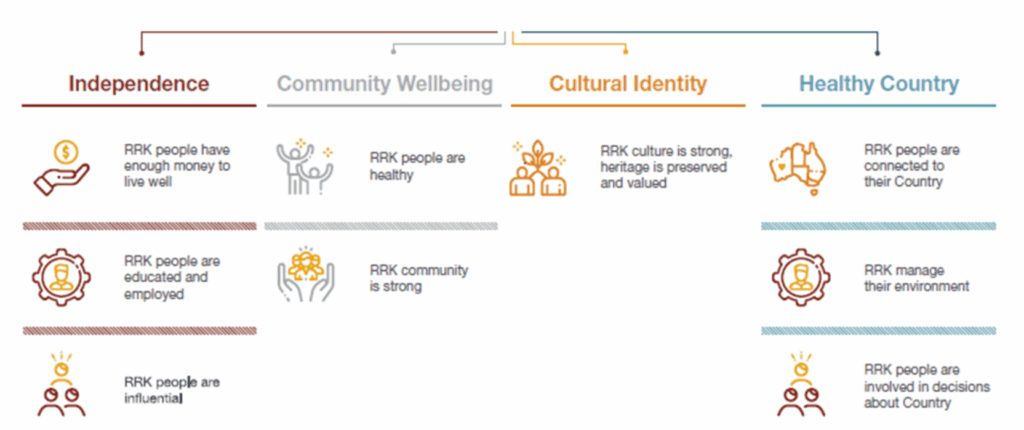
RRKAC’s vision is to collaborate as a community to establish a solid foundation towards independence, community well-being, cultural identity and healthy Country.2RRKAC, About us, Robe River Kuruma Aboriginal Corporation RNTBC, June, 2024, [link]
Cultural legitimacy in RRKAC’s corporate structure
RRKAC’s governance is deeply rooted in community control, with a strong focus on inclusive and culturally appropriate representation. The Robe River Kuruma community is at the heart of RRKAC’s governance and drives its corporate values. They are instrumental in the strategic plan development process and have strong representation in RRKAC’s decision-making bodies.
RRKAC’s corporate structure respects RRK People’s customary decision-making processes, ensuring they have a voice in discussions and are fairly represented and responded to:
“Community is at the core of all decision-making processes within the Corporation. Notwithstanding the Robe River Kuruma Board of Directors, comprising of Apical representatives, holding legal authority for decisions, our traditional governance processes, enables various committees, made up of the wider RRK community group, to regularly provide recommendations to the Board on various issues. Ultimately, all key decisions come back to the Robe River Kuruma Community for endorsement. Our traditional customs and governance are reflected in the way we operate.”
-Kelly Slattery, Chair RRKAC
As of 2025, RRKAC has grown into a team of nearly 50 dedicated and hardworking staff members. While many are based at the main hub in Karratha to engage directly with community, others work remotely in roles that are not community-facing. Together, they pursue the strategic priorities identified by the community and manage RRK resources wisely and effectively. Strong communication and engagement processes ensure the RRK community remains informed, empowered, and connected to their corporation’s performance.3Nicholas Haney, Chief Operating Officer, interviewed by Ana Maria Parada, Australian Indigenous Governance Institute, online, July 10, 2025.
RRKAC’s Heritage Advisory Committee (HAC) also helps ensure RRKAC is operating according to the cultural needs and values of the community. The HAC is focused on culturally legitimate representation on matters relating to Native Title, culture, and heritage. The HAC is composed of senior members of the RRK community, and two identified emerging cultural leaders who have been appointed by the community to speak with authority on such matters.4 Robe River Kuruma Aboriginal Corporation, Robe River Kuruma Strategic Plan 2021-2024, [link] Mining proponents must consult the HAC regarding the interests of the RRK People, as well as the protection of Country. This includes concerns related to water and heritage sites, which may be affected by mining activities.
RRKAC’s risk management and sustainability
RRKAC’s primary source of funding comes from mining agreements. Mining royalty payments are held and managed by RRKAC’s subsidiary company, Kuruma Marthudunera Limited (KML).
RRKAC and KML work closely together and have a crossover of directors on their boards for consistency across their governance structure. The Chair sits across KML, RRKAC and Robe River Services PTY Ltd (RRS), the subsidiary company and business arm of RRKAC. This facilitates communication among the three different entities, allowing for early risk identification and intervention.
KML identified that a heavy reliance on mining royalty payments posed a significant risk to the corporation’s long-term sustainability. These payments are subject to external market factors, such as fluctuating mineral prices or the closure of mining operations.
The corporation has been successful in obtaining alternative sources of funding such as government grants and expanding cultural heritage services. In addition, the RRK Future Fund was created to manage and invest funds for future generations of RRK People. These resources are governed by an Accumulation Policy which dictates when this funding can be accessed. The intention for this funding is to provide for future generations when revenue generated from mining has ended.5Robe River Kuruma Aboriginal Corporation, Robe River Kuruma Annual Report 2023-2024, [link]
Robe River Services Pty Ltd (RRS) is an entity of Robe River Kuruma Aboriginal Corporation, developed to be a driver of economic opportunities for the Robe River Kuruma People and community.
RRS has a mandate to build an economic base by generating self-determining revenue streams through commercial business, employment, and capacity building opportunities. In addition to identifying emerging commercial opportunities, RRS also help incubate and grow RRK owned businesses, and have also undertaken projects to analyse the business and employment opportunity pipeline with key stakeholders, aligned to a thorough skills audit of the RRK community.
These ongoing initiatives will propel the corporation and its members toward the ultimate goal of achieving sustainable financial independence.6Robe River Kuruma Aboriginal Corporation, Robe River Kuruma Annual Report 2023-2024, [link]
Related topic:
RRKAC working in partnership
RRKAC and KML have a responsibility to work collectively to deliver the RRK vision. They do so through a foundation built on trust, accountability, innovation, transparency, and making decisions collaboratively for the betterment of the RRK community.
The Joint Boards collaborate to identify RRK needs and priorities and to develop strategies to achieve positive outcomes for community, culture, and Country.
The Role of RRKAC
The role of RRKAC is to hold RRK determined lands in trust for the RRK people and progress the broader interests of the RRK membership. RRKAC represents the RRK people in their dealings with industry, government, and the private sector. RRKAC monitors and implements obligations under the RRK people’s various participation agreements, provides services that protect and preserve RRK cultural heritage, and utilises charitable trust funds to deliver programs for the betterment of the RRK people. RRKAC are the doers – they are on the ground working with RRK people representing their rights and interests in mining agreements, delivering programs and protecting their Country. They are the eyes and ears of the RRK people.10Nicholas Haney, Chief Operating Officer, e-mail to Australian Indigenous Governance Institute, 4 November 2025.
The Role of KML
The role of KML is to ensure that the RRK funds sitting in the Trust are well managed. KML guides how charitable trust funds are utlilised to bring about change now and for future generations. KML makes investment decisions that ensure social and economic benefit for RRK people now and into the future. KML is RRK’s investment bank. They hold the money from compensation and make sure it is used according to the rules, benefits RRK people, grows over time, and sustains the work of RRKAC.
Related topic:
Succession Planning at RRKAC
RRKAC fosters and encourages emerging leaders to speak up and have a voice, and empowers them with skills in leadership, organisation, governance, advocacy and negotiation to fulfil their future roles.
Understanding the complexity of the governance structure, compliance, partnerships, and decision-making can be intimidating and daunting. The number of mining agreements and companies the board deals with can seem overwhelming. RRKAC works with their young people to become familiar with this knowledge in a safe environment.
In 2025, RRKAC’s most recent development in succession planning includes the formation of a Future Leader Program to prepare young people with skills and knowledge to serve as the future leaders in their communities. Participants are matched with a mentor from the Corporation’s Leadership team, and are also encouraged to develop and implement programs in an area of their interest, which can include culture, community or well-being. The program also includes opportunities to attend workshops, masterclasses, and attend board and committee meetings. The Program can also support participants to take up tertiary education.
Succession planning at RRKAC also involves diverse measures to safeguard the longevity and sustainability of the organisation. Director’s terms are capped at two three-year terms to allow new ideas and views to flow into the organisation’s leadership.
Additional layers of governance also ensure the community’s voice is present in RRKAC’s decision-making. The RRK Peoples’ corporate structure has been developed to incorporate ‘customary’ decision-making processes. Their governance systems are therefore based on carefully validated cultural and family structures, including apical representation on the RRKAC Board of Directors. The guidance of RRK People, particularly the Traditional Owner Council (TOC) as spokespeople for the community and the Heritage Advisory Committee (HAC) as RRK culture and heritage advisors to RRKAC, has considerable cultural authority within the group.12Nicholas Haney, Chief Operating Officer, e-mail to Australian Indigenous Governance Institute, 4 November 2025.
Jajiwurra Rangers
For over 30,000 years, the RRK People have cared for their Country using traditional connections that have been passed down through generations.
In August 2023, RRKAC officially launched their own Jajiwurra Rangers program that facilitates the maintenance of a healthy Country and healthy culture. The program helps ensure RRK people can continue to contribute to and enjoy cultural, social, environmental, and economic outcomes of their lands and waters.15RRKAC, Country and Culture, Robe River Kuruma Aboriginal Corporation RNTBC, June, 2024, [link]
The planning and development of Jajiwurra Rangers was guided by cultural land management practices. RRKAC also had the support of Desert Support Services and the Pilbara Cultural Land Management Project (PCLMP), which supports Pilbara Traditional Owner groups to implement cultural and conservation land management across the region. The program’s policies and procedures align with the RRK Strategic Plan and RRKAC’s Healthy Country Framework, which aims to ensure culture, people, and knowledge are central to caring for Country.16Robe River Kuruma Aboriginal Corporation, Robe River Kuruma Strategic Plan 2021-2024, [link]
The Jajiwurra Rangers program places culture at the heart of decision-making processes. While the current ranger team have been carrying out extensive environmental monitoring in the region, RRKAC recognise that at times rangers are required to do long commutes to facilitate their roles on Country. As being on Country is an important cultural need of the RRK community, RRKAC decided to utilise their partnership with Rio Tinto and negotiate the building of a ranger base in Pannawonica. RRKAC is also seeking NIAA Indigenous Ranger Program funding to expand their footprint on areas of high cultural significance, such as the Bungaroo Cultural Precinct, Jajiwurra (Robe River) and the Gunarika Cultural Precinct.
They have formed an RRK Women Ranger Team to address the gender imbalance in the field and promote equal opportunities and skills in environmental management and cultural conservation.17Nicholas Haney, Chief Operating Officer, e-mail to Australian Indigenous Governance Institute, 4 July 2024.Empowering women to step into these roles develops their leadership capabilities and promotes the preservation of gender-based knowledge. Establishing a women’s team ensures that RRKAC can uphold cultural protocols in their environmental and cultural heritage. The inclusion of women-specific traditional knowledge and responsibilities is essential for effective, holistic caring for Country programs.
The Jajiwurra Rangers Program has high engagement from the RRK people. Rangers have started weed management out on Country, giving traditional owners a way to meaningfully engage with Country and protect it.18Nicholas Haney, Chief Operating Officer, interviewed by Ana Maria Parada, Australian Indigenous Governance Institute, online, July 10, 2025. RRKAC will be following the program’s development closely, with much attention focused on the many benefits that working on Country is bringing to the rangers, including increased wellbeing for participants, the model of service delivery and how it connects back to governance.19Nicholas Haney, Chief Operating Officer, Australian Indigenous Governance Institute, 2024.
Related topic:
References
- Nicholas Haney, Chief Operating Officer, e-mail to Australian Indigenous Governance Institute, 4 July 2024.
- Nicholas Haney, Chief Operating Officer, interviewed by Ana Maria Parada, Australian Indigenous Governance Institute, online, July 10, 2025.
- Nicholas Haney, Chief Operating Officer, Australian Indigenous Governance Institute, 2024.
- RRKAC, About us, Robe River Kuruma Aboriginal Corporation RNTBC, June, 2024, [link]
- Robe River Kuruma Aboriginal Corporation, Robe River Kuruma Strategic Plan 2021-2024, [link].
- RRKAC, Country and Culture, Robe River Kuruma Aboriginal Corporation RNTBC, June, 2024.[link]
Stay connected
Stay informed with AIGI news and updates.